Posts Tagged ‘horse
Clicker Trained Horses are Happy Horses
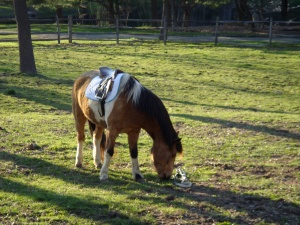
Yesterday I was out at the barn to exercise my new project pony, Boomer (Chesapeake Boomerang). My three Chincoteagues currently live outside in a large run-in shelter, and as I mentioned in earlier posts I frequently brush them/tack them up/etc. inside the shed while they are untied. I’ve been stressing lately that building a trusting bond with your horse will cause them to enjoy your visits and not always expect to be “worked” when you show up. I also think that not only that, but the fact that I frequently clicker train my horses while riding them (food and the clicker are fazed out once the desired skill is achieved) makes them enjoy being ridden. They are all happy to see me when I show up, no matter if I have a saddle, a brush or a treat in hand.
I took this short video to demonstrate how being ridden is not a big deal to my horses, they see it as nothing to fear or dread, because I have made it an enjoyable experience always.
Boomer waiting patiently to be ridden
Most horses (especially the ever stubborn ponies) would head for the hills at the site of their “rider” carrying a saddle out to them in their pasture. And if you notice in the video not once do I offer Boomer a treat (or click him), I simply call his name and use a “kiss” sound (I use this as my signal to all my horses when I want their attention: Lets them know its me and to them its a sound that triggers a positive experience). I have never had to clicker train Boomer to behave this way when approached out in the field, it simply is a response from working with him positively under saddle – I’m sure if I attempted this when he first came to live with me he likely would of took off in the other direction. If he had been a “problem” horse to catch I certainly would of clicker trained him to react in a different way – but from day one I gave him no reason to fear being ridden.
From here Boomer and I went on a nice relaxing trailride with my mom and Blitz (Chesapeake Lightning). Boomer had fun racing up the hills – this time he actually beat his big brother (and taller brother) Blitz, he’s got racing potential for sure!
Service Pony
Many have probably heard of Panda, the miniature horse turned seeing eye guide, but I thought I would post a video I found of her anyway. Its amazing what positive reinforcement training (clicker training) can achieve.
Research has shown that any creature—whether a dog, cat, dolphin, parrot, fish, horse, llama, or person—is more likely to learn and repeat actions that result in consequences it desires and enjoys. So clicker trainers provide consequences desired by their animal in exchange for actions or behaviors desired by their trainers.
We call these consequences “rewards” and the process is called “reinforcement.” Clicker training, therefore, is a positive-reinforcement-based system of training.
Panda’s trainer, Alexandra Kurland is one of the world’s leading horse clicker trainers – and I have been fortunate enough to learn from one of her pupils, Katie Bartlett of Elverson, PA. In 2005 I discovered Katie’s website and promptly set up a demonstration with her for my local pony club. This was my first introduction to clicker training (I had already been working with Minnow on tricks, but I was interested to find out about other training methods). After our session I was completely hooked,
Minnow playing fetch at the lake
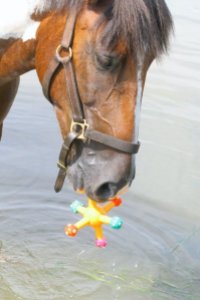
I had watched as she had her horses perform fun tricks like sitting, laying down, dunking a basket ball and I had also watched her collect her horse at liberty and ask him to perform lateral movements. Immediately after the demo I purchased my first clicker and the rest is history. I have to admit I only read one short book on how clicker training worked, but its such an easy concept to understand that I never felt the need to purchase more materials. The hardest part is trying to perceive how your horse will understand what you are asking – and breaking it into small steps for them. For example picking up an object – I wouldn’t just shove something in my horses face and wait for him to put it in his mouth, I would first ask him to touch it, once he mastered that I would ask him to open his mouth around it by no longer clicking when he touched (I would expect my horse to naturally problem solve – ok why am I not getting food when I touch it anymore, maybe I should try opening my mouth). Then I would ask him to grasp the object, and then actually lift it out of my hand. I love when I can actually see my horse problem solving.
Minnow bowing on command
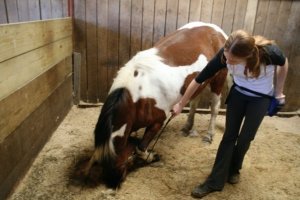
Everytime I teach Minnow something new I can tell the exact moment he begins to think – and I can even tell when he can’t figure out what I want. Minnow’s default reaction to something he can’t solve is to give me a kiss. It actually stems back to the very first thing I ever taught him (to kiss me), if he can’t figure out what I want he will just keep kissing me over and over again. Its great in a way because then I know that I need to go back and break what I’m asking him into even smaller steps. Minnow even has developed a signal to let me know that he’s frustrated with the task at hand. If he starts to bow repeatedly I know he’s getting frustrated and its time to take a break. I find that the very best thing about clicker training is that it has created a way for me to communicate with my horses – I think its absolutely amazing that Minnow has discovered how to give me signals for confusion and frustration on his own (and they aren’t rooted in a buck or a rear or even a nip).
A Natural Connection
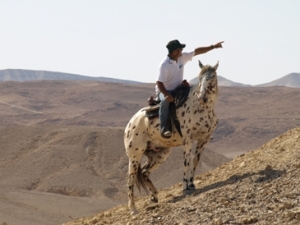 I came across an interesting video of a horse training process called “natural connection” which has been developed by Uri Peleg. His website doesn’t go into much detail about how he achieves this connection with his horses, but its very interesting none-the-less. He briefly touches on the benefit of riding his horse bridless, and the harmfulness of using a bit.
I thoroughly enjoy riding all of my ponies bridless when possible, but I don’t think it would be possible for me to compete with them without some sort of bridle (I currently use a bitless bridle). My boys would definitely need a lot more intense training to achieve this – but it would be amazing. I do have a goal in mind of having my current project pony, Boomer, competing in mounted games with barely any rein pressure while executing tight turns and spins at top speeds. He’s got the foundation right now, but we still have a long way to go. Its very difficult to train him more precisely without a riding ring currently, but when we make our big move to Iron Horse Farm I hope to have a much more suitable place for his training. Anyway, watch Uri’s video and I hope it inspires you to create a much better partnership with your horse.
Ponies Featured in Artwork
New artwork featuring the ponies of PonyPaintings.com has arrived! Artist BJ Redmond frequently features my ponies in her work.
A little bit about her: My name is Barbara, BJ for short. I live in Michigan with my husband. I am 66 years old and disabled (lupus). I used to raise horses, american saddlebreds, arabs and half breeds for 20 years. I have always loved horses. As a child, I painted horses horses horses. Once I had some horses, i stopped painting and actually forgot about art. About 3 years ago, I was going through depression and boredom and a christian lady online got me started on ebay. After purchasing about $1,000 worth of art, i remembered, “hey, i can do that.” since then I have resurrected the old talent and have been painting, drawing and, much to my joy, selling my finished pieces. I do many other critters on occasion, but find horses remain my joy.
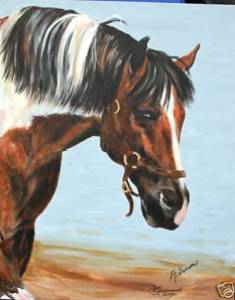
Painting by BJ Redmond of Chincoteague Minnow
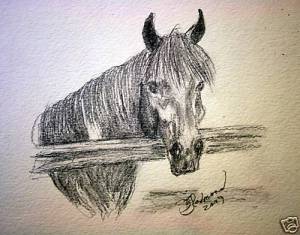
Pencil Sketch of Chesapeake Lightning by BJ Redmond
Music to my Horse’s Ear
I came across a website today with some surprisingly addictive music on it. I don’t consider myself a “fan” of country music at all really, but for some reason the music of artist Mary Ann Kennedy made me laugh and want to jump in the saddle all at the same time.
Grammy nominated hit songwriter from Nashville, TN., Mary Ann Kennedy, creates music that celebrates the horse. A dedicated Parelli Natural Horsemanship student herself, Mary Ann seems to express what we all feel in our hearts for our beloved horses and the life we all live with them. Through melody, rhythm and humor in song, this is music that we horse lovers can listen and ride to.
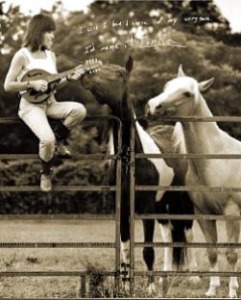 It was interesting to find out that the artist is also a Parelli follower, with many of her songs made specifically for the Parelli program. Horsenality being one of the most recognizable Parelli ones to me (I haven’t really followed the program, but on occasion I receive articles and readings from my instructor who is a dedicated follower of Parelli – I’ve discovered that I have 2 left brained ponies and one right brained one). Horses in Heaven was sort of a neat song for me, made my think of one of my childhood ponies that I lost last summer unexpectedly, he had been with me since I was 10 years old. You can see a photo tribute to my beloved, Oopsie Daisy by clicking HERE. On the lighter side of things I thought Barn Cat was pretty humorous, there are some other great ones on her website too. I thought some of the songs might be great to perform to with my horses. Anyway, enjoy!